


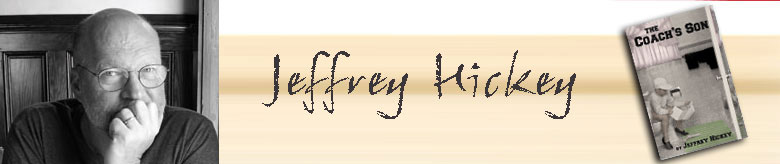
























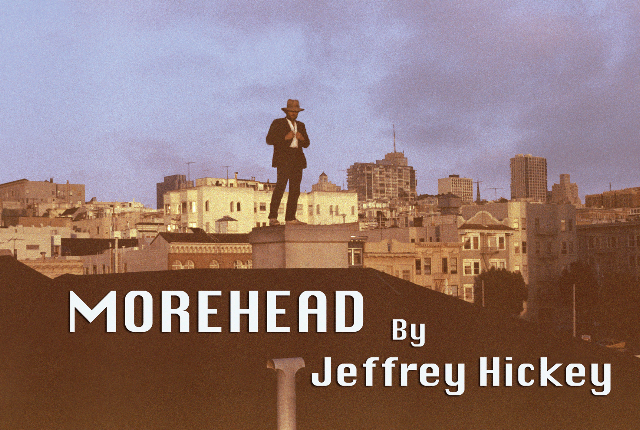
Patrons of a 101-year-old bar in Limerick, Ireland will gather on July 20 to hear Inverness author Jeffrey Hickey read from his 2012 self-published novel, Morehead. Mr. Hickey will share portions of his “loosely autobiographical” coming-of-age story courtesy of the Limerick 2018 Gay Games X Bid Team.
The book is set mostly in San Francisco, but news of it has hopped the Atlantic by way of a chapter written about the first Gay Games, a multi-sport competition modeled on the Olympics that started in San Francisco in 1982.
Mr. Hickey and his wife, Karen Kiser, had already planned a trip to Ireland as a 28-years-belated honeymoon. (The couple married during a lunch break, in black sweatshirts and jeans, at San Francisco City Hall.)
The Gay Games Federation, for whom Mr. Hickey had read a Morehead excerpt at a Games 30th-anniversary party last year, put Mr. Hickey in touch with the bid team, one of three finalists along with London and Paris campaigning to host the 10th Games.
Morehead, in part, is meant to blur the distinctions between straight and gay men, “using the language of a straight man to convince other straight men not to be so scared,” Mr. Hickey said. He thinks people at the Games do not view the story as necessarily gay or straight: “It’s just human.”
Morehead also features a lot of sex. Chapter one, “College,” mentions an erection in the first paragraph. By chapter 23, “Reminders,” all of the blunt, first-person accounts of lustful thoughts and hooking up have plotted an overarching Bildungsroman about finding a common humanity that transcends perceptions of sexuality.
Still, Mr. Hickey relishes surprising audiences with the book’s carnal anecdotes, or what he calls “going completely swishy on them,” at readings. He alternatingly voices “six multi-ethnic gay men” when he reads aloud chapter 11, “Roger’s Place.”
The content, and perhaps Mr. Hickey’s exuberant delivery, has upset audiences before, such as during a spring 2012 open mic at a monthly poetry reading in the Blackbird café in Inverness. At least a couple of people walked out. Others, Mr. Hickey said, laughed uproariously.
“You’ve got this group that’s dying and this other group that’s dying,” Mr. Hickey said. “Chapter one is anything but poetic.”
Mr. Hickey looks forward to more auspicious tidings on July 20.
“That particular day will be the 18th anniversary of my mother’s passing,” he said. “She’s the one who taught me to write. She was one of the most graphically inappropriate people and, as such, taught me that I should be the same way. So that will be powerful, just to feel her that particular day.”
Mr. Hickey is comfortable with “misty mornings and pearly dew drops” not being his thing. He wrote children’s books and taught public speaking at Bay Area schools before the family moved from Mill Valley to Inverness in the mid 90s. Then the shackles came off, he said.
Mr. Hickey’s first novel was The Coach’s Son, a sports story drawing on superstition and Southern mores, then Morehead, and, this October, Scary, Man, about a family navigating small-town dynamics in Mill Valley and Inverness.
“I made sure there’s nobody out here that’s referred to that anybody could possibly go, ‘Oh, he’s talking about so-and-so,’” Mr. Hickey said. “As the saying goes, you don’t crap where you eat.”
Mr. Hickey very much likes where he eats. His love-at-first-sight wife has had a Pixar “dream job” for nearly 20 years, including working as an animator for the films Toy Story and Cars. Their two-acre Inverness property has a swing Ms. Kiser hung from an old buckeye tree in the backyard, which Mr. Hickey insists all visitors take for a spin.
“This is my life. This is my heaven.”
Parts of “allegedly liberal West Marin” may not embrace his work, but Mr. Hickey says his spouse does, as do their 25-year-old twin sons.
“I would say that [the twins] probably went into a bit of a transition when I started to write for adults, because they loved and missed the children’s storyteller, but they also knew that wasn’t the real Jeff,” Mr. Hickey said. “That was Jeff being the children’s storyteller. That wasn’t dad that they knew who was capable of saying anything at any time. They’re very supportive now of the work that I’m doing, because it’s really who I am.”
Mr. Hickey plans to retire from writing fiction rooted in reality for a while. His next novel will be written from the perspective of that centuries-old buckeye tree.



